
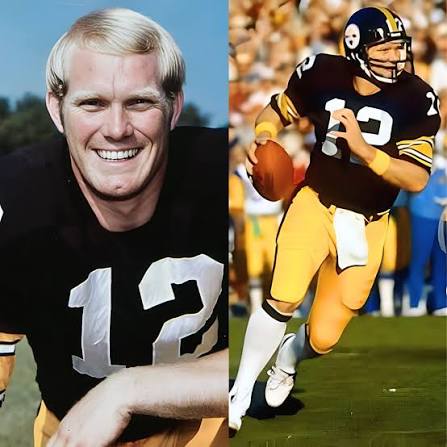
Some athletes leave the game and slowly fade. Terry Bradshaw did the opposite. After leading the Pittsburgh Steelers to four Super Bowl titles in six seasons, he stepped away from the field in 1983 and immediately began building a second career that would eventually make him more famous than his playing days ever did. At 77, still a fixture on FOX NFL Sunday, Bradshaw remains one of the most distinctive personalities in sports media — loud, emotional, self-deprecating, and impossible to ignore.
The numbers from his playing career are impressive on their own: four Super Bowl rings, two Super Bowl MVP awards, an NFL MVP in 1978, and a first-ballot induction into the Pro Football Hall of Fame. Yet those achievements only tell half the story. The other half is the three-decade run as a broadcaster, entrepreneur, and cultural figure who turned a strong right arm and an even stronger personality into lasting relevance.
The Arrival
In 1970 the Pittsburgh Steelers held the first overall pick in the NFL Draft and used it on a big-armed quarterback from Louisiana Tech named Terry Bradshaw. The choice was not without risk. Bradshaw had dominated at a smaller school, but the leap to the professional game proved difficult. Early seasons were marked by interceptions, inconsistency, and public frustration. Critics questioned whether the strong-armed prospect would ever put it all together.
What changed was time, coaching, and the gradual construction of one of the greatest teams in NFL history. Under Chuck Noll, surrounded by the Steel Curtain defense and emerging offensive weapons like Franco Harris, Lynn Swann, and John Stallworth, Bradshaw matured into a confident, aggressive quarterback who thrived in big moments. By the mid-1970s the questions had disappeared. The only remaining debate was how many championships the Steelers could win.
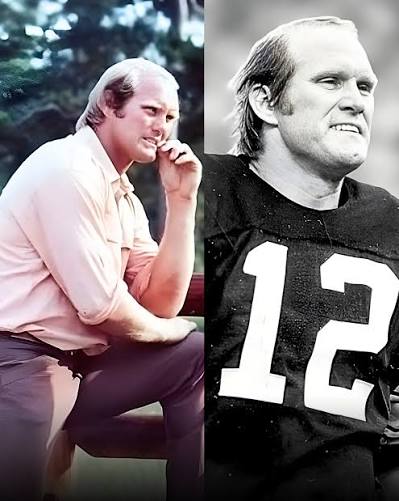
Bradshaw’s early years in Pittsburgh were rocky, but the foundation for a dynasty was already being laid. (Placeholder)
Building the Dynasty
Between 1974 and 1979 the Steelers won four Super Bowls. Bradshaw started all four. He threw the decisive touchdown pass in Super Bowl X, earned MVP honors in Super Bowl XIII after a 318-yard, four-touchdown performance against Dallas, and repeated as MVP the following year in Super Bowl XIV. He became the first quarterback in NFL history to win three Super Bowls, then the first to win four.
The 1978 season stood as his individual peak. Bradshaw led the league in touchdown passes, earned All-Pro recognition, and was named NFL Most Valuable Player. More importantly, he had fully grown into the role of leader on a team that refused to lose in January. His deep ball remained a weapon, but his willingness to take risks and his visible emotion on the field made him the perfect face of a blue-collar dynasty that captured the imagination of a generation of fans.
Career Snapshot
Life After Football
When Bradshaw retired after the 1983 season, few expected him to become a television institution. He began with CBS, then made the jump to the newly formed FOX Sports when the network acquired NFL rights in the mid-1990s. Since the launch of FOX NFL Sunday in 1994, Bradshaw has been a constant presence — first as a colorful analyst, later as one of the central personalities of the pregame show.
His style never pretended to be polished. Bradshaw laughed loudly, got emotional, teased his colleagues, and frequently made himself the punchline. That authenticity connected with audiences in a way more measured analysts rarely could. More than thirty years later he is still there, now in his late seventies, still refusing to slow down. In recent interviews he has made clear that retirement holds little appeal. “The day you retire is the day you start dying,” he has said, quoting Billy Graham. At 77 he continues to treat the studio as his second stadium.
The Business Side
Bradshaw’s post-playing career has extended well beyond the broadcast booth. He has released country and gospel albums, appeared in films and television shows, and built a collection of business interests that include Bradshaw Bourbon, food products tied to his Oklahoma ranch, and a family cookbook. Estimates place his net worth around $45 million — modest by the standards of today’s top quarterbacks, yet substantial for a player from his era who successfully converted fame into long-term commercial value.
The real currency, however, has always been personality. Sponsors and networks learned that Bradshaw delivered something rare: genuine connection with a broad audience. Whether selling products, hosting a pregame show, or simply appearing as himself, he brought the same larger-than-life energy that once filled Three Rivers Stadium.
What Remains
Terry Bradshaw occupies a unique place in NFL history. He is one of only a handful of quarterbacks to win four Super Bowls, the first to do so, and a first-ballot Hall of Famer. Yet his cultural footprint is larger than the championships. For millions of fans who never saw him play, he is the loud, emotional, silver-haired man who has spent Sunday mornings talking football for more than half their lives.
At an age when most of his contemporaries have long since left the public stage, Bradshaw continues to work, joke, and refuse the quiet exit. The strong arm that once stretched defenses is no longer the story. The voice, the laugh, and the refusal to fade have become the lasting legacy. Four rings got him into the Hall of Fame. The second act made him permanent.
James Harrington has covered the NFL for more than two decades and is based in Florida.